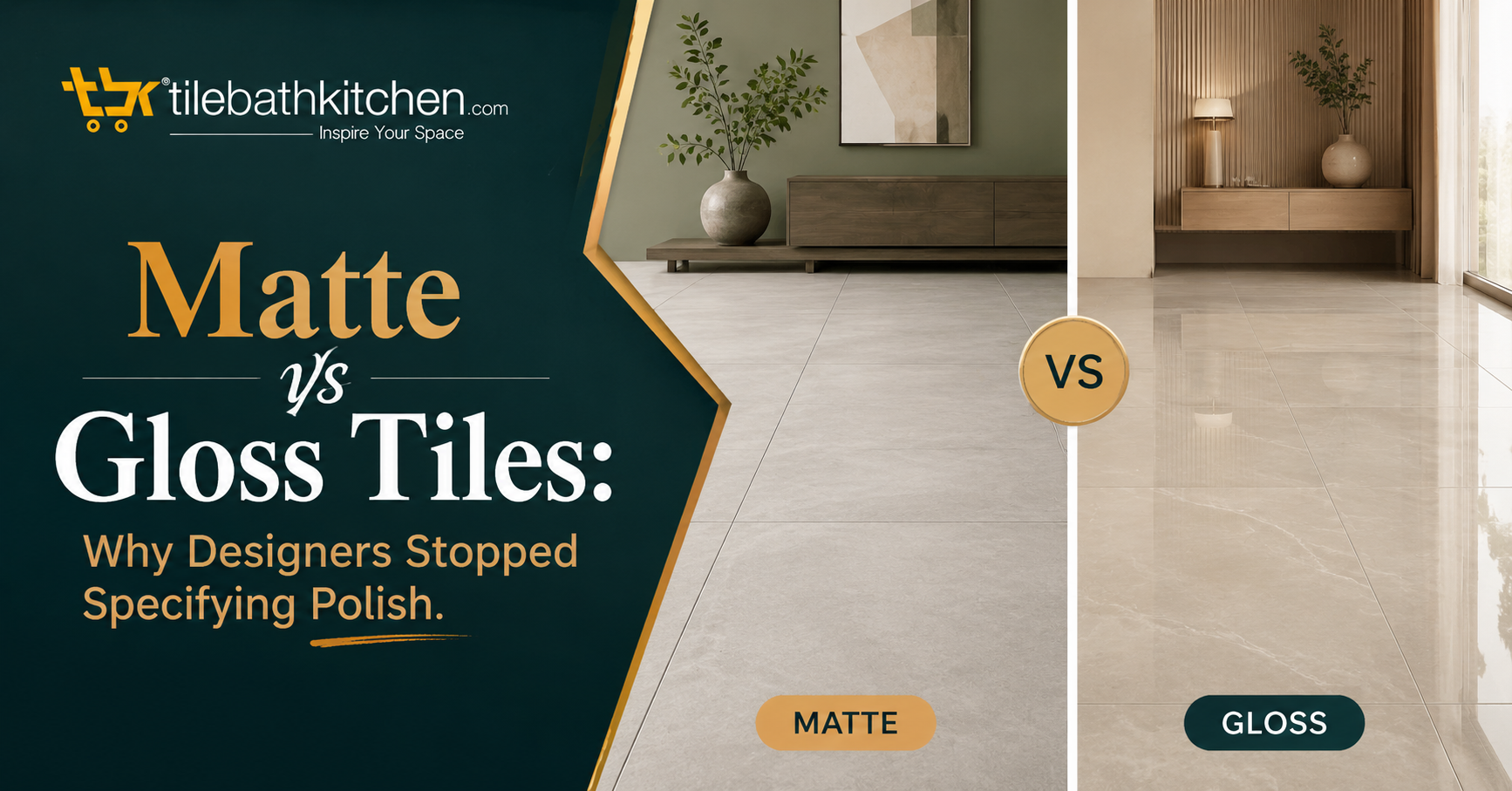
Walk into a showroom and the glossy tiles win. They are lit to shine, laid on a small clean display panel, and they look expensive. Then they go into a home and the calculation changes completely.
Here is what actually separates the two finishes over a decade of use.
How each finish ages
This is the argument that has moved professional specifiers toward matte.
A polished tile has a smooth, reflective surface. Every footstep leaves microscopic scratches. Those scratches do not appear evenly — they concentrate along traffic paths. Five to ten years in, a polished floor is visibly duller along the route from the door to the sofa than it is under the furniture. There is no fixing it short of professional re-polishing.
A matte tile has no gloss to lose. The micro-scratches it accumulates are invisible against an already diffuse surface. A matte floor at year ten looks essentially like it did at year one.
For a floor you intend to keep for fifteen years, that is decisive.
Cleaning and daily appearance
Gloss shows everything: dust, footprints, water spots, hard-water scale, streaks from a mop. In Indian conditions — dry season dust, monsoon wet feet, daily mopping — a polished floor demands constant attention to look good.
Matte hides dust and footprints well. Its weakness is the opposite: a heavily textured matte surface can hold grime in the micro-texture and need scrubbing rather than wiping. A smooth matte or lappato finish is the balance point.
Light and space
Gloss reflects and bounces light, so it can make a dark room brighter and a small room feel larger. This is the one genuine advantage, and it is real in a north-facing flat with limited windows.
But reflection cuts both ways. Under modern LED downlights, a polished floor produces hard glare spots and mirrors the ceiling fittings back at you. In rooms with strong artificial lighting, gloss often reads cheap rather than luxurious.
Matte diffuses light softly and shows the tile’s actual colour and pattern rather than a reflection of the room.
Safety
Polished tile plus water is the most common cause of domestic slips. Any wet area — bathroom, kitchen, balcony, entry lobby, stair — should be matte or textured. This is not a preference; it is a specification requirement.
Where each finish belongs
Matte: bathroom floors, kitchen floors, balconies, terraces, entryways, staircases, any home with young children or elderly residents, and any floor you want to look good in ten years.
Lappato (semi-polished): living and dining floors where you want some light bounce without full gloss. The best compromise for marble-look tiles.
Gloss: wall tiles, feature panels, backsplashes above the working zone, and small dark rooms where light bounce genuinely helps.
The marble-look exception
If you are buying a marble-effect tile specifically to imitate polished marble, full polish is the honest choice — a matte marble-look tile reads as neither. Just accept the maintenance that comes with it, and keep it off high-traffic floors.
The short answer
Matte for floors, gloss for walls, lappato when you cannot decide. If a salesperson pushes polish for a bathroom floor, walk out.
FAQs
Which is better for flooring, matte or glossy tiles? Matte, in almost all cases. It resists visible wear, hides dust, and is far safer when wet.
Do glossy tiles make a room look bigger? They reflect light, which can help in small dark rooms, but under LED downlights they also create glare and mirror ceiling fixtures.
Are matte tiles harder to clean? Smooth matte tiles are easy to clean. Heavily textured matte surfaces can trap grime and need scrubbing rather than a quick wipe.